Some Fun and Inspirational Pictures

I blew off digging postholes today due to the wind and rain.  The contractors came today to give us bids on the doors and house painting.  Once this is done the house will be watertight and the major projects will be completed.  It has been a year since we started the bidding process on the farm.  What a tremendous amount of work we have done since that time!

861232_534136553326057_1489353519_o

564564_10151727122817993_2035515687_n

1381509_487993861298026_1868927004_n

311608_378840935560870_999469118_n

10601_487180694657031_1820229187_n

1044355_636964153001977_401753066_n

555444_10151905840773809_1531691696_n

1238309_536082366461254_576111926_n

1374357_10151975534481842_948355319_n

1382018_10153276362950244_744783477_n

And just to insert my own sense of sarcasm and cynicism:

487524_328046447292255_617729031_n

The Latest In Our Broken Food World

http://farmandranchfreedom.org/gmo-harms-reproductive-and-digestive-health/

http://www.huffingtonpost.com/andrew-gunther/industry-assurances-over-_b_4039594.html?utm_hp_ref=@food123

http://www.examiner.com/slideshow/bt-corn-and-intestinal-disorders#slide=1

http://gmoseralini.org/seralini-validated-by-new-efsa-guidelines-on-long-term-gmo-experiments/

http://www.senseaboutscience.org/for_the_record.php/114/does-a-viral-gene-found-in-gm-food-raise-safety-concerns

http://www.independentsciencenews.org/commentaries/regulators-discover-a-hidden-viral-gene-in-commercial-gmo-crops/

http://www.nytimes.com/2010/03/12/business/12seed.html?pagewanted=all&_r=1&

I Love My Post Hole Digger!!

I got out in earnest today and began digging the post holes to fence in the garden and coop.  If ever there was a device worth its cost it is this beastie!  When the ground is dry here it is extremely hard.  When it is wet though, it is pretty easy to get through.  I found that out by trial and error over the past few months and even more so today.  This tool can dig out a 30 inch deep 9 inch wide hole in just a couple of minutes.  I hope to have a third or more of them done by the end of the weekend.

The only issue is that the auger itself can over power the tractor.  My little tractor is 23 horsepower.  It is quite a workhorse but the auger acts like a wine bottle opener.  If the corkscrew gets into the ground it will keep on digging in deeper and deeper completely overwhelming the hydraulics on the tractor’s 3 point hitch.  You know the ground is hard if it can stall out a tractor.  It dug itself into one hole and practically pulled the front tires off the ground.  I have had to get it unstuck a few times and am learning some of the tricks needed to get it free.

The fencing guys who were out earlier this year taught me a trick that I’m going to have to use.  Because the ground is more pliable when wet, they force a power washer gun down into the ground to get it moistened.  Even with the moisture we have had the past couple of weeks the ground is only wet the first few inches below the surface.  The rest is dry like a sandbox.  Getting the sub-soil moistened will hopefully help keep from drilling this thing to China.  There were a couple of instances where it drilled itself into the ground right down to the gear box.  Not such a great thing.  Through some rocking back and forth and other maneuvers it finally broke free.  The manual says to have several replacement sheering bolts handy because if it gets stuck it can snap them off.  Haven’t had that happen yet, but one is a bit bent.  Live and learn.  I am just so grateful that I am not having 1. To pay to have someone do this (the auger has already paid for itself) and 2. Not have to dig these almost 3 foot deep holes by hand!  Once this is done I get to learn how to use a fence stretcher to tension out the fence and nail it to the posts.  Always something going on.

The project after that, as it will still hopefully be winter and the garden won’t be workable for awhile, is to build the second coop in the chicken run.  We debated back and forth today on how to make that happen.  Because this coop will be for raising meat birds it doesn’t need to be nearly as elaborate as the layer’s house.  They don’t roost, they won’t lay eggs so they don’t need nesting boxes and they will only be in the pen for about 5 or 6 weeks.  They need a place to sleep, an automatic door to protect them just like the layers, it doesn’t need electricity or any kind of heated waterers as they will be raised in the spring to early summer.  The expense that was put into the layer coop will likely be put into the processing equipment (kill cones, scalder, plucker, stainless steel tables, freezer and the like).  After all, gotta keep the USDA (or USDUH) happy.  Salmonella is a very bad thing.

The puzzle had to do with the layers in the summer time.  The section of the barn where the new coop will go is also the place where the layers go during the day to escape the sun.  What we came up with is a way to have wide swinging doors that will allow access to that part of the barn, but can also be closed off when the meat birds are in it.  It is a very bad idea to introduce new birds to an existing flock.  It screws up the pecking order and can stress them out (stressed layers stop laying).  So instead of building and fencing in a whole new coop it looks as though we are going to be able to do it all in one place.  A very nice thing as I wasn’t really too keen on paying for a whole 2nd coop set up.

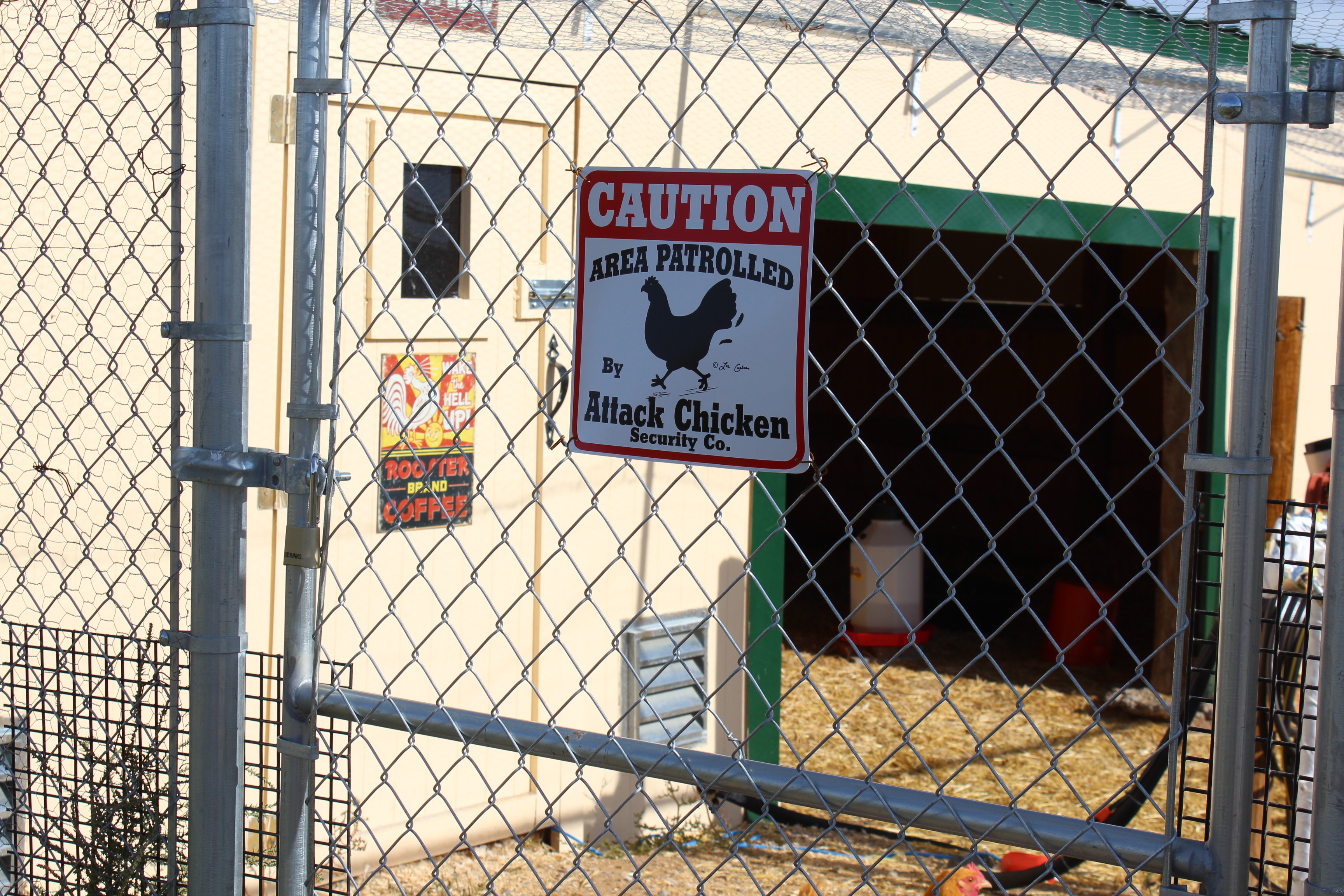
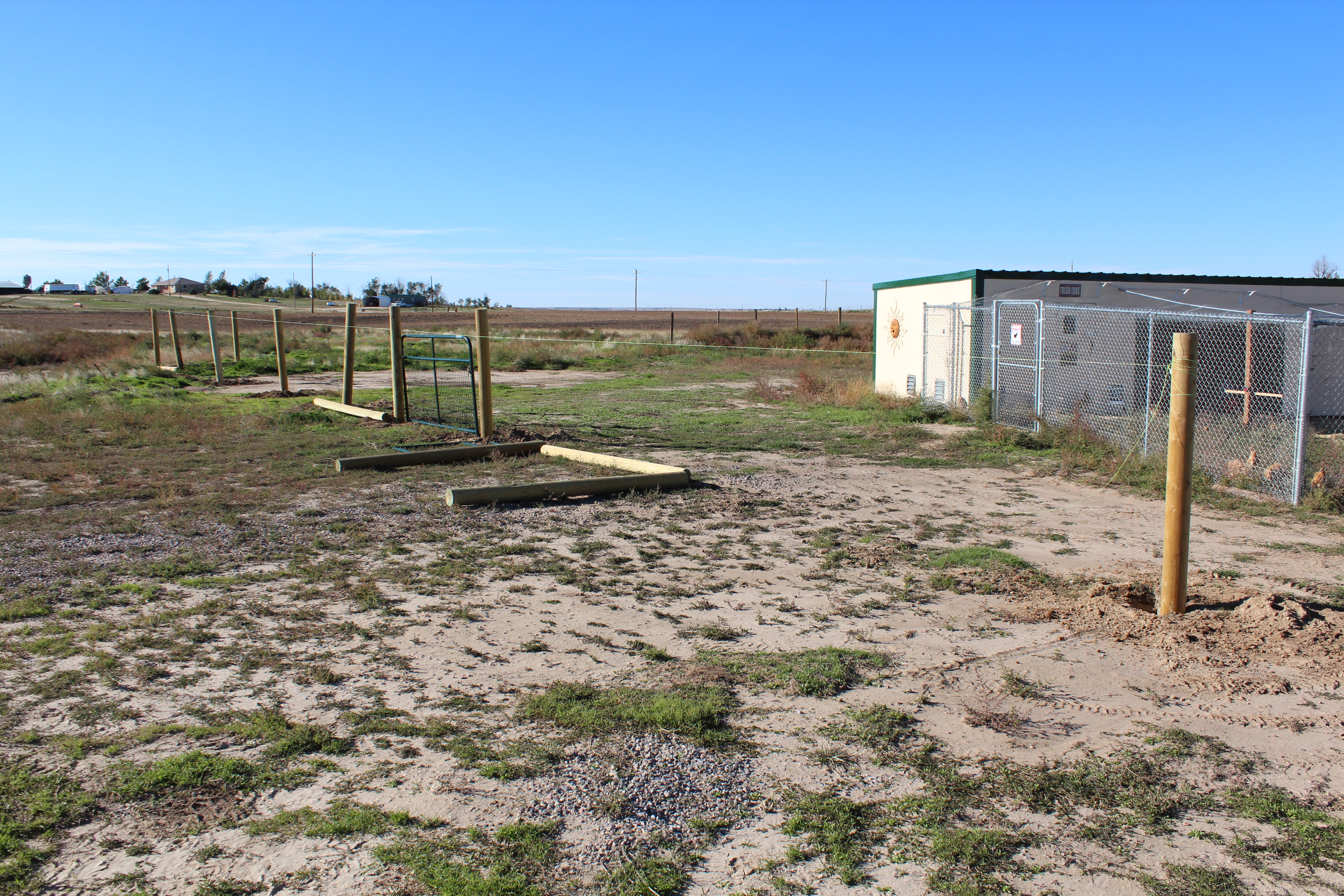
Here are some pictures of the beginning of the fencing project and a couple of cute signs we put up on the barn itself (The one below the window is hard to read.  It says, “Rooster Brand Coffee”  The rooster is exclaiming, “WAKE THE HELL UP!”)   At least one of the roosters today was trying to get his cockadoodledo on.  It was pretty humorous.  It sounded like a teenager who’s voice is beginning to change.  We will likely have roosters joining the chorus of roosters to the north and south of us very soon.  Some people hate that sound, I think it is “wonderful”.  The girls are all having their little skirmishes trying to establish their pecking order.  They have also turned out to be BIG food wasters.  I filled one feeder yesterday with about 25 lbs of feed and they had flicked most of it out onto the ground by the end of the day today.  They call it “billing out”.  They peck into the food and when they do, a bunch of it gets thrown out onto the ground.  Oh well, I guess if they run out when I’m not here they can just scratch and peck it off of the barn floor!

PS:  May some sanity finally prevail in Washington.  These children shouldn’t be governing.  I’m getting too old and burned out to keep having to do financial planning via crisis management.  I refuse to melt down again because of having to defend people against criminals.  Selling chicken eggs is starting to look better and better all the time!!!

IMG_2826

IMG_2831

IMG_2830

IMG_2837

IMG_2838

IMG_2839

I Guess Wall Street Agrees: “Pursue an agriculture degree, and you’ll be rich.”

Because my real job as a financial advisor keeps me focused on the events going on in the world – currently the Tea Party gubbermint shutdown- I have to read these crazy financial websites.  As I’ve said previously, if you want to know what the citiots and wealthy are saying to each other read financial websites and journals.  More often than not they seem entirely out of touch with reality, but in recent months there has been something of an undercurrent with respect to farming.  Many are trying to assert that the reason that folks should consider a career in farming is because we will need to feed 9 – 10 billion people in the next half century.  While that may be true, as my previous post asserts, we are probably going to be stupid enough to try to do that with energy, land, and capital intensive, industrial means.  This article though, and several others, are suggesting it as a way to avoid a potential collapse.  Some are bold enough to say it directly, this one a little less so, but the subtler message seems to be, “something is bleeped up”, we all need food, there are not going to be a lot of industrial jobs, Wall Street is coming unhinged, and we are running out of everything (a recent financial post suggested that MIT’s Limits To Growth  – that we are going to essentially run out of most resources by 2030 – is spot on

{  http://www.cnbc.com/id/101051828   }  ).  The headline screamed that CEO’s and industry leaders were trying to figure out how to keep our infinite growth model going by improvements in technology and magic.

This quiet paradigm shift to agriculture, I think, speaks volumes.  No one wants to wake up the frogs in the warming pots of water.  They are whispering that the writing is on the walls and if you want to survive, you better have 1. the ability to support and feed yourself, and/or 2. have skills (like doctors and vets and general contractors and repair specialists and seamstresses, and all manner of homesteading skills) that others will need and can be used to support you.

For those who have not heard of them or not read them from my bibliography posted on JAZFarm blog,  I would strongly suggest the novel, “A World Made By Hand” by James Howard Kunstler or his more serious book, “The Long Emergency”.  Another would be,  “Peak Everything” by Richard Heinberg of the Post Carbon Institute.  You may want to subscribe to Peak Moment TV on the web (or watch their videos on You Tube).

Suffice it to say that if the citiots, the greedy, and the hard and fast believers in pure “capitalism” (whatever that really is) are talking about digging in the dirt……..   someone is waking up.  Get ahead of them, grow things, learn skills and more importantly….. make sure your kids do.  After this recent shutdown BS going on in Washington, a truism is that they will not be there to help you.  Create community, bring your family close, grow your own food, get in shape, get some callouses on your hands, buy good boots, and get busy.  Remember, there is no such thing as a plant that grows Pizza, Burgers and fries.  Wheat, potatoes, lettuce, tomatoes, cucumbers, peppers, carrots, corn, beans, spinach, onions, garlic, etc. all of these can be turned to pizza and beer and things much better and tastier!  Learn how to preserve food, how to grow year round even in winter, raise backyard chickens, and turn your neighborhood into a collective farm.  Learn to compost:  Turn REAL BS into compost, and use it to grow something useful.  Verbal BS simply raises the blood-pressure.

The fight being set up between this post and my last about losing 100,000 farmers by 2020, will be between those that want to control the land and those who will NEED the land.  The rest of our lives are setting up to be pretty interesting.

Jim Rogers: Skip the MBA, get an agriculture degree

Jim Rogers: Skip the MBA, get an agriculture degree

   Text Size  

Published: Friday, 4 Oct 2013 | 9:55 AM ET

By:  | CNBC Producer

Jim Rogers believes the finance industry is about to slip into secular decline. That’s why the famed investor advises young people to pursue careers in farming rather than in finance.

“If you’ve got young people who don’t know what to do, I’d urge them not to get MBAs, but to get agriculture degrees,” Rogers told CNBC.com.

David Jones | E+ | Getty Images

That’s because the financial commentator and author of “Street Smarts: Adventures on the Road and in the Markets” is bearish about the entire financial field.

“Finance has been good the past 30 years, but it was not good the 30 years before that, and it’s happening again,” Rogers said. “Finance is in decline. In the future, the center of the world will not be finance—it’s going to be the producers of real goods.”

Economist Robert Shiller recently raised the related question of whether the “best and the brightest” are doing to the world a disservice by going into finance. In a September column in Project Syndicate, the Yale economics professor asked: “Are too many of our most talented people choosing career in finance—and, more specifically, in trading, speculating, and other allegedly ‘unproductive’ activities?”

(Read moreWant to get an MBA? So do a lot of others)

Play Video
Rogers: ‘I Know It’s Going to End Badly’
Investor Jim Rogers explains why he’s not investing in U.S. stocks right now.

After all, there is a good argument that the agriculture field will present more compelling problems to solve.

“We are going to be trying to feed 9 billion people by 2050 with the same number of acres of arable land,” said Timothy Burcham, dean of agriculture and technology at Arkansas State University. Calling that task “overwhelming,” Burcham notes that “the opportunities for a person that has a graduate degree in agriculture are great now, but they are going to be really, really excellent going into the future.”

Rogers is factoring the expected rise of the agriculture industry into his investing thesis. “Recently, I’ve been looking at agriculture stocks,” Rogers said. “I’ve been excited about looking for things to buy in agriculture.”

(Read moreFarming equipment: Agriculture gets its own ‘Apple v. Windows’ battle)

And in a late Wednesday telephone interview from Singapore, Rogers’ prediction even took on a personal tone. He advised this writer: “Pursue an agriculture degree, and you’ll be rich.”

—By CNBC’s Alex RosenbergFollow him on Twitter: @CNBCAlex.

Watch “Futures Now” Tuesdays & Thursdays 1 p.m. ET exclusively onFuturesNow.CNBC.com!

Like us on Facebook! Facebook.com/CNBCFuturesNow.

Follow us on Twitter! @CNBCFuturesNow.

This is Very Bad News

WE HAVE INDEED LOST OUR MINDS!!!  IF THIS IS INDEED TRUE THAT WE ARE GOING TO LOSE CLOSE TO 100,000 FARMERS AND RANCHERS BY 2020 OUR MORAL COMPASS HAS INDEED BEEN BROKEN.  THIS MEANS DIRECTLY THAT THE DIRECTION IN AGRICULTURE POLICY WILL BE TO MORE BURNING OF FUEL, MORE IMPORTS, LOSS OF TOPSOIL, LOSS OF DIVERSITY, LOSS OF SPECIES, LOSS OF TRADITION AND KNOWLEDGE…. IN SHORT… THE END.  WE ARE EXPECTED TO RUN OUT OF PHOSPHOROUS BY 2020, A KEY COMPONENT OF INDUSTRIAL FERTILIZER…. THEN WHAT?  AMMONIA BASED FERTILIZER IS LARGELY BASED ON NATURAL GAS AND THAT IS IN DECLINE.  THEN WHAT?  WE ARE APPROACHING PEAK OIL SO SHIPPING FOOD FROM OVER SEAS (ONE OF THE BIGGEST PRODUCERS OF LETTUCE – OF ALL THINGS – IS PRODUCED BY CHINA!)  THEN WHAT?  A REPORT WAS PUBLISHED ON CNBC RECENTLY THAT SAID THE WORLD WILL BE TAPPED OUT OF RESOURCES BY 2030!!  RIGHT IN LINE WITH MIT’S LIMITS TO GROWTH…. THEN WHAT?
 
ANSWER:  WE NEED TO REVERSE THIS TREND.  WE NEED TO PUT PEOPLE BACK ON THE LAND AND TEACH THEM HOW TO GROW FOOD, WE NEED TO ENGAGE IN ROTATIONAL GRAZING, ORGANIC SOIL BUILDING AGRICULTURAL PRINCIPLES AND DE – URBANIZE OUR LANDSCAPE!!!  SUBURBIA IS THE BIGGEST WASTE OF RESOURCES IN THE HISTORY OF THE WORLD!!  WHAT WOULD YOU DO, IF YOUR CITY COULDN’T GET FOOD TO IT?  THINK ABOUT IT….. THIS IS REALLY BAD.

Is Your Job About to Become Career Roadkill?

Seven Jobs That Might Disappear Soon

By Dona DeZube, Monster Finance Careers Expert

You don’t need a crystal ball to know that in the not-too-distant future, advances in technology and changing consumer preferences will crush the careers of some people who are very happily employed at this very moment. You can just look at Bureau of Labor Statistics (BLS) data.

If you’re in one of these seven shrinking jobs, you can either start looking now for a way to transfer your skills and knowledge into a new job, or tough it out and hope the guy next to you gets the ax instead of you:

Gaming Cage Workers

Even though there’s probably a new casino opening near you, demand for gaming cage workers is actually expected to decline by an unlucky 13 percent between 2010 and 2020, the BLS says.

Since gamblers are using self-service machines to buy and cash in chips instead of going to your cage, a better bet for your career is in a field with a more optimistic employment outlook: healthcare. A community-college course in medical billing should help you learn the medical terms you’ll need to know to land a job as a billing clerk — a field projected to grow 20 percent by 2020, according to the BLS.

Auto Insurance Claims Adjusters

Cars are getting safer, which is good news for drivers, but bad news for auto insurance claims adjusters who have fewer accident claims to work. The BLS projects an 8 percent decline in jobs for auto claims adjusters between 2010 and 2020.

If you believe global climate change will lead to a continued uptick in natural disasters, a shift into property and casualty claims adjusting might be a good move for you. Look for opportunities to cross-train via your current employer, or seek out online or community-college classes to pick up knowledge of other insurance lines and the industry’s popular software programs.

You can also boost your employability as a property and casualty adjuster by picking up a bachelor’s degree in a related field like engineering or construction, or by acquiring knowledge of a specialty insurance niche like green building or art.

Floral Designers

Every time you buy flowers in the grocery store instead of ordering an arrangement from a florist, you contribute to the decline in demand for floral designers.

With the industry projected to lose 6,200 jobs between 2010 and 2020, up the chances of hanging on to yours by staying abreast of current trends, earning industry certifications and expanding your skill set intospecial-events coordination, says Thomas Shaner, executive director of the American Institute of Floral Designers. You could also consider teaching flower-arranging classes to all those people buying cut flowers.
!!!!!!!!!!!!!!!!!!!!!!!!!!!!!!!!!!!!!!!!!!!!!!!!!!!!!!!!!!!!!!!!!!!!!!
>>>>>>>>>>>>>>>>Farmers !!!!!!!!!!!!!!!!!!!!!!!!!!!!!!!!!!!!!!!!!!!!!!!

Between 2010 and 2020, some 96,100 farmers and ranchers will go out of business, the BLS says. “As land, machinery, seed, and chemicals become more expensive, only well-capitalized farmers and corporations will be able to buy many of the farms that become available,” the BLS predicts. “These larger, more productive farms are better able to withstand the adverse effects of climate and price fluctuations on farm output and income.”

Farmers can either fight ‘em by niche marketing (think organic produce grown for local restaurants) or join ‘em by moving into farm management for an agribusiness corporation or, for those who like the business side of farming, agriculture consulting. If you’re up for a completely new career, consider agricultural appraising, says Cheryl L. Cooley, communications manager for the American Society of Farm Managers and Rural Appraisers.

Power Plant Operators

If you turn off the lights when you leave the room, you’re killing jobs. Along with energy efficiency, new power plants requiring fewer employees to run them will lead to a 3 percent decline in the number of power plant operator jobs between 2010 and 2020, the BLS says.

You can try to switch over to water plant management, but the pay over there is worse (the annual median salary for water plant operators is $41,780 compared with $65,280 for power plant operators). Nuclear power plants are where the money is ($76,590 median annual salary), and new nuclear power facilities have gained approval.

Loan Interviewers and Clerks

Need a mortgage? There’s an app for that, and it’s putting loan interviewers and clerks out of work. The BLS projects a decline of 5,700 jobs for loan interviewers and clerks between 2010 and 2020.

With the real estate market on the upswing, a move into real estate sales might work if you can afford to live off your savings while you establish your real estate business.

The same skill set you use in collecting and analyzing would-be borrowers’ financial information would also come in handy at an IRS job, while your sales skills could apply in an insurance sales job.

Semiconductor Processors and Electronic Equipment Assemblers

You can blame it on the robots, efficiency experts or offshoring, but whichever you choose, there are still going to be 14,200 jobs gone from these two fields between 2010 and 2020, the BLS says.

Cover your assets by switching into an assembly job or fabrication job in a more prosperous sector ofmanufacturing, like aircraft products and parts. If you can handle the math, go back to school for an associate’s degree and become an electronic engineering technician. Not only will you be more employable, but you’ll boost your paycheck as well. The median salary for electrical and electronics engineering technicians is $56,900, according to the BLS.